Queer Places:
5 Smith Square, London SW1P 3HS, UK
Preston Cemetery, Walton Ave, North Shields NE29 9NJ, United Kingdom
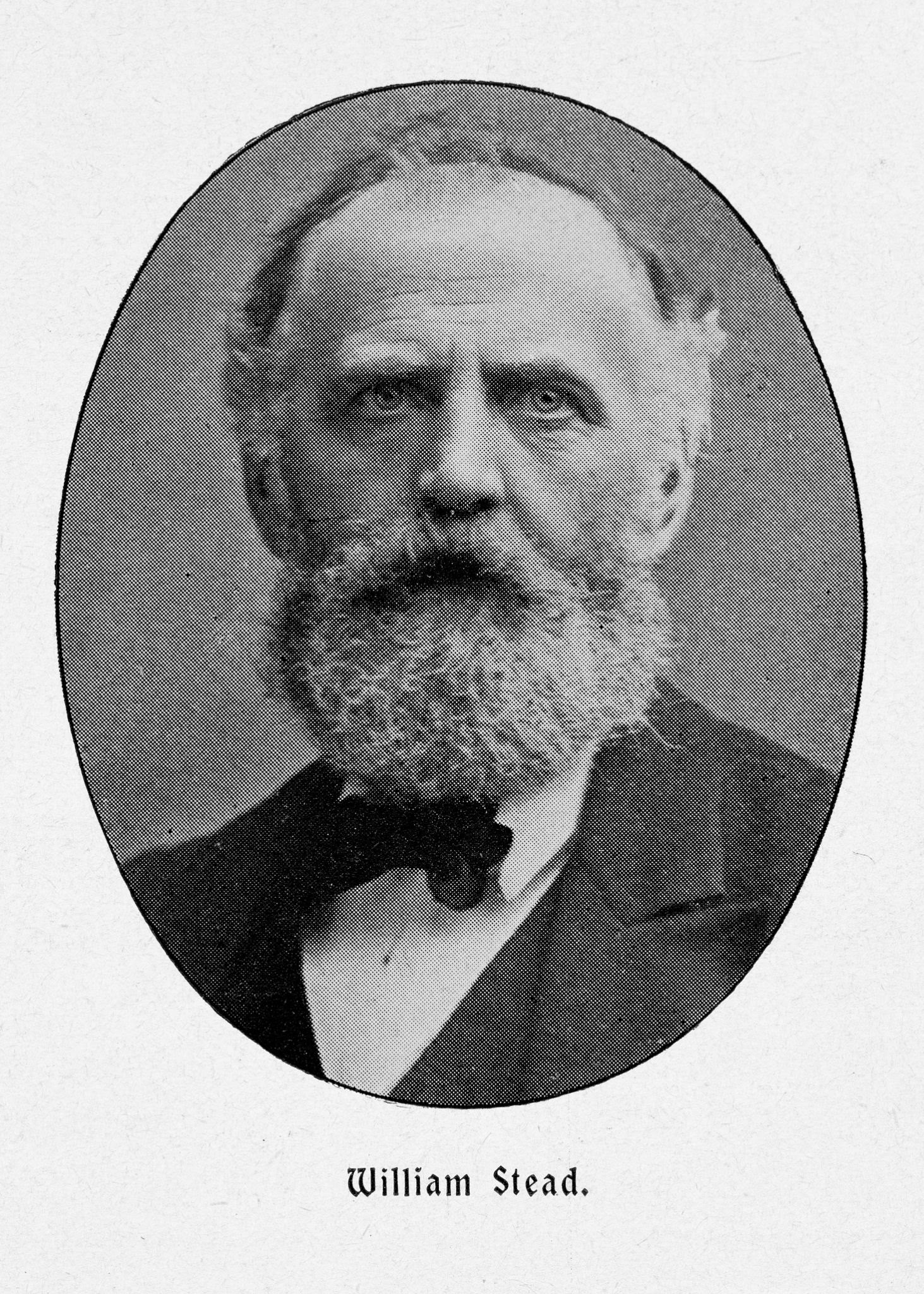 William Thomas (W. T.) Stead (July 5, 1849 – April 15, 1912) was one of the most influential, sensational, and controversial figures of Victorian journalism. Known as a
pioneer of "New Journalism," he transformed newspapers into tools for moral crusades, investigative exposés, and social reform.
William Thomas (W. T.) Stead (July 5, 1849 – April 15, 1912) was one of the most influential, sensational, and controversial figures of Victorian journalism. Known as a
pioneer of "New Journalism," he transformed newspapers into tools for moral crusades, investigative exposés, and social reform.
Born in Northumberland, England, Stead was raised in a devout Congregationalist household, which deeply shaped his lifelong sense of moral crusade and spiritualism.
As editor of the Northern Echo and later the Pall Mall Gazette, Stead invented techniques still central to media today: interview formats, bold visual typography, map
diagrams, and investigative undercover work.
His most famous campaign, the "Maiden Tribute" Campaign (1885), aimed to raise the age of consent from 13 to 16. To demonstrate how easy child trafficking was in
London, he staged the "purchase" of a 13-year-old girl named Eliza Armstrong. The resulting exposés succeeded in changing the law (the Criminal Law Amendment Act 1885),
but technical illegalities in how he purchased the girl led to his imprisonment for three months.
In his later years, he became deeply interested in spiritualism, world peace movements, and international diplomacy. He died aboard the RMS Titanic in April 1912
after helping women and children into lifeboats.
Stead's role in LGBTQ+ history is intriguing, morally complex, and fraught with contradiction. While he was not an early defender of gay rights in the modern sense,
his writing surrounding Oscar Wilde and the laws of the era reveals a nuanced, surprisingly perceptive legal critique.
The irony of Stead's career is that the very legislation brought about by his 1885 campaign against child exploitation contained the infamous Labouchere Amendment
(Section 11). This clause outlawed "gross indecency" between men in public or private—the exact law under which Oscar Wilde was later prosecuted in 1895.
While Stead's primary goal was stopping female child prostitution, the broader bill created the legal tool used to criminalize male homosexuality in Britain for
decades.
Despite his strict Victorian moralism, Stead's response to Oscar Wilde’s conviction for "gross indecency" in May 1895 stood out for its analytical candor. In his
periodical, The Review of Reviews, Stead offered a defense of Wilde that focused on hypocrisy and individual variation:
Stead pointed out the hypocrisy of Victorian law, arguing that if Wilde had engaged in heterosexual adultery or seduced young women, society would have ignored or
forgiven it:
"If Oscar Wilde, instead of indulging in unnatural vices, had corrupted the wives and daughters of half his peers... no one could have laid a finger upon him."
Stead was among a rare few prominent journalists to suggest that Wilde’s desires were intrinsic rather than a chosen perversion, noting that Wilde’s "‘unnatural’
propensities were not unnatural for him."
Stead did not personally approve of homosexuality—he viewed it through a Victorian moral lens—but he consistently opposed class hypocrisy and selective justice. His
willingness to question why the legal system punished private acts between consenting men while turning a blind eye to heterosexual exploitation made his commentary an
important milestone in early legal debates surrounding sexual ethics.
References:
Other references:
- https://en.wikipedia.org/wiki/W._T._Stead
- https://www.encyclopedia-titanica.org/titanic-victim/william-thomas-stead.html
- https://archivesearch.lib.cam.ac.uk/repositories/9/resources/1850
Support this project
This website is a passion project researched, developed, and funded entirely by me. If you find the content valuable and would like to help support the ongoing research and hosting costs, any contribution is deeply appreciated.
Thank you for keeping this independent resource alive!
My books on Amazon: Elisa Rolle's books
BACK TO HOME PAGE
